
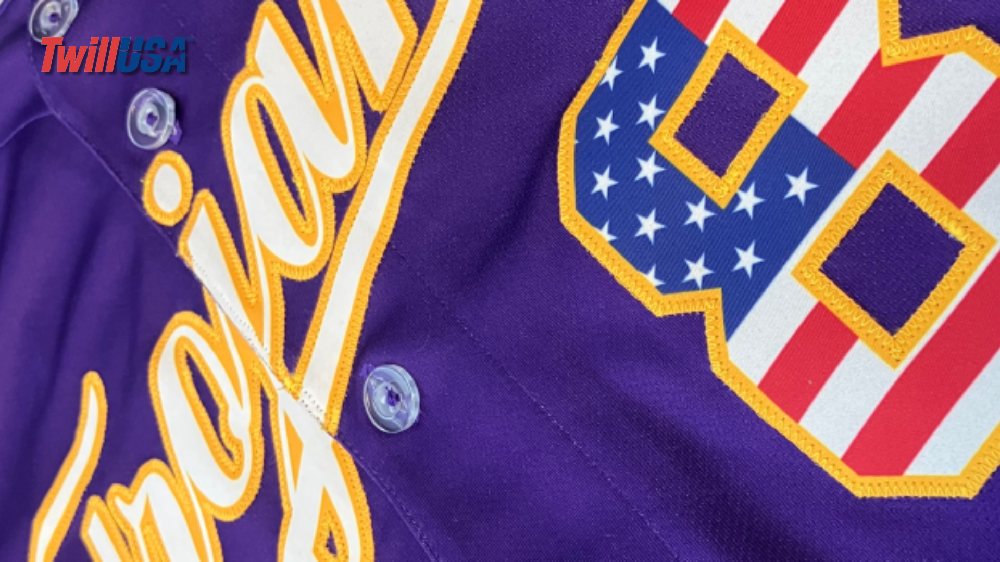
Manufacturers select materials that withstand physical play, repeated laundering and public scrutiny. Tackle twill earns its reputation through structure stitchability and visual weight. When combined with complementary decoration methods such as flocked HTV, it reinforces why twills fabric remains a foundational material in professional sports apparel.
The Evolution of Jersey Decoration in Professional Sports
Initial sports jerseys were based on screen printing and basic sewn art. Leagues were growing, and merchandising became more visual and long-lasting. Teams shifted towards overlay fabric applications that held form and color under stress. Tackle twill was another reaction to this change and provided stitched dimensional lettering, which did not peel or fade away during extended seasons.
What Defines Tackle Twill in Professional Apparel?
Tackle twill is a highly woven piece of cloth that was used to create applique lettering and numbering. The manufacturers stitch it but do not bond it to the surface; they stitch into it and cut it into specific shapes. This technology produces raised, lasting graphics, which are incorporated into garment making.
Tackle twill does not lie over the cloth, as does surface film or ink. It becomes incorporated in the jersey structure. This feature distinguishes it from other means of decoration and is the reason why it has been able to survive in elite sports settings.
Durability That Matches Athletic Performance
Jerseys are exposed to a lot of stretching, friction, and laundry among the professional football players. Materials that are not able to survive under such conditions bring about discrepancy and replacement expenses. Tackle twill does not lose edge integrity and color stability during high-impact usage.
Comparatively decorative films like flocked HTV play useful purposes in fashion and fan apparel. Such applications are usually used by teams in controlled settings as opposed to game-worn jerseys. The engineered materials used in making performance-driven garments are those that are required to endure stress, which the twill offers.
Visual Authority on the Field and Screen
Broadcast visibility has an effect on the choice of material. Lettering is raised to ensure a sense of contrast and clarity in the dark backdrop of a stadium and in camera pans. Flat graphics cannot be easily followed through the motion.
Twill is dimensional and helps in brand recognition.The structure of twill's fabric helps in sharpening edges and color division that leads to a clean uniform appearance when played on TV.
Stitching as a Structural Advantage
The jersey is reinforced with stitching. As numbers and names undergo a stitched reinforcement they spread the load of stress over seams instead of adhesive bonds. This type of construction will enhance the life of the garment, and they will be in place during movement.
Some teams integrate hybrid designs combining tackle twill bases with accent, with flocked HTV creating the desired texture. The selection of these combinations by designers is aimed at preserving the performance level and increasing the visual freedom.
Consistency Across Large Scale Production
Professional leagues demand uniform consistency across hundreds of garments. Tackle twill facilitates accuracy of cutting and the repetitive stitching process. The size, shape, and location are regulated by manufacturers with little variation.
The surface-applied materials undergo change when subjected to heat, pressure, or fabric stretch. By comparison, stitched twill has batch-to-batch dimensional accuracy. This has helped to cement its role in professional supply chains.
Why Teams Trust Twill for Long Term Identity?
A team identity is developed gradually. Jerseys are traditional and legacy. Authenticity has non-performance symbolic significance. Tackle twill is appropriate in that respect because of its classic crafting and its tested durability.
Decorative trends shift regularly. Materials such as flocked HTV adapt well to short cycle fashion releases. Core jerseys have the advantage of having materials that oppose the seasonality of trends and maintain identity.
Maintenance and Lifecycle Efficiency
Jerseys are washed regularly by teams. Degradable materials add operation friction. Tackle twill can withstand industrial washing without collapsing or distortion.
This is the durability that lowers the replacement rate and facilitates sustainable inventory management. Twill fabric is produced as intended throughout the lifecycle of a jersey that is attractive to both the teams and manufacturers.
Why Professional Standards Resist Full Replacement?
Other forms of decoration also keep developing. Both of them present advantages to certain usage scenarios. They are all interchangeable with stitched twill in a professional game setting.
Leagues prefer consistency as opposed to innovation. Tackle twill meet that standard through measurable performance outcomes rather than visual trends alone.
Conclusion
Professional sports jerseys demand materials that perform consistently under pressure. Tackle twill delivers durability clarity and structural integration unmatched by surface decoration alone. While complementary methods such as flocked HTV expand creative options, the foundation remains rooted in quality twills fabric. For teams and manufacturers seeking longevity and authority Twill USA continues to support those standards through engineered materials and decades of industry expertise.
Frequently Asked Questions
- Why do professional teams prefer stitched lettering?
Stitching enhances the use of graphics in the construction of the jersey, which enhances the durability of the garment plus its ability to maintain visual clarity under stress.
- Is tackle twill heavier than other decoration methods?
It adds structure without excessive weight. Athletes experience minimal impact on mobility.
- Where does flocked HTV fit into sports apparel?
Designers use it for accent elements, fan wear and controlled fashion applications rather than core gameplay jerseys.
- How does twill handle repeated washing?
It retains shape and color as well as edge integrity during industrial laundering conditions.
- Can tackle twill support modern design trends?
Yes, designers use stitching patterns, layering, and color blocking without compromising the performance standards.